my student dorm ran on post-its and a WhatsApp chat. so i built an app.
Hundreds of students, one WhatsApp group, and post-it notes everywhere. I spent 7 months building witelli20 — a dorm management app with room reservations, live transport, and an anonymous confession board.
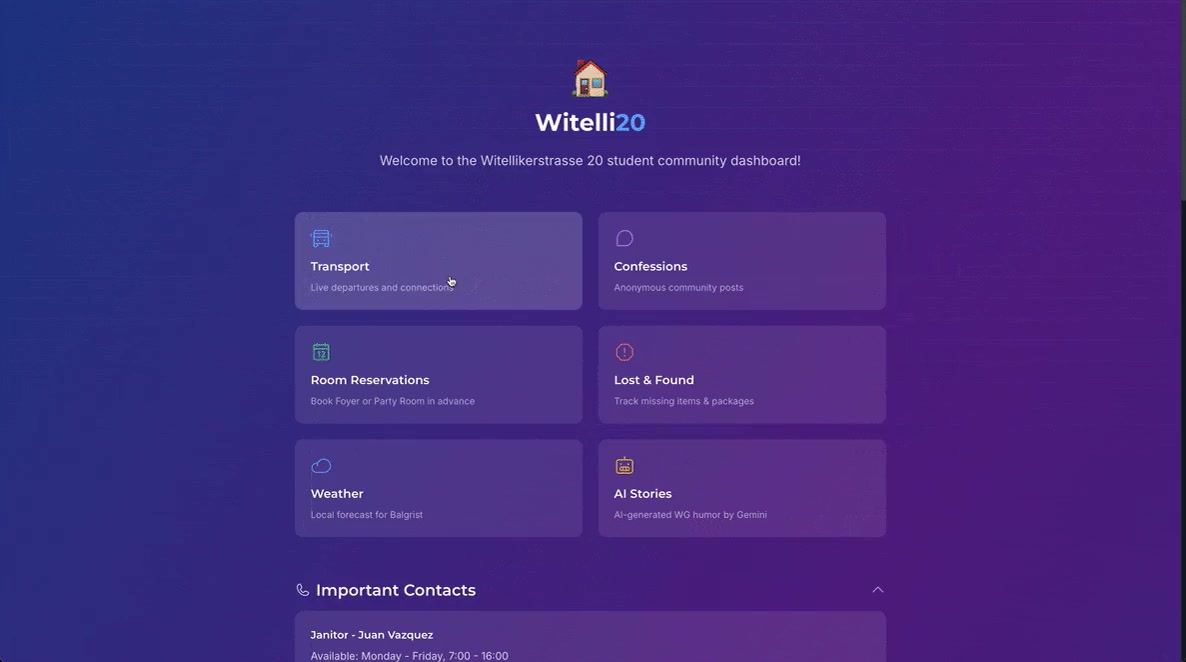
hundreds of students. one WhatsApp group. post-it notes on the common room door. welcome to student dorm management in 2025.
the chaos before
my dorm had the classic problem: too many people, not enough communication infrastructure. here's how things worked:
room reservations: you'd walk to the common room, check if someone left a post-it on the door, and hope nobody else had the same idea. double bookings were a weekly occurrence. passive-aggressive post-it wars were a monthly tradition.
information sharing: one WhatsApp group with 200+ members. important messages about maintenance, events, or quiet hours would get buried under memes within minutes. trying to find "when is the laundry room closed?" in a chat with 300 unread messages is an exercise in patience.
transport info: everyone googling the same bus schedule every morning. "does the 31 still run after midnight?" asked and answered roughly 400 times per semester.
lost & found: a cardboard box in the lobby. items would sit there for weeks. owners had no idea their stuff was found. finders had no idea who to contact.
something had to change.
the solution
i built witelli20 — a web app that replaces the post-its, consolidates the WhatsApp chaos, and adds features nobody knew they needed.
room reservations. calendar view for every bookable room. see what's available, reserve a slot, get confirmation. no more double bookings. no more post-it wars. the calendar shows who booked what, so there's accountability.
live transport departures. pre-configured for the routes students actually take. connections to ETH, UZH, ZHAW, FHNW, and ASVZ — the places students go every day. real-time data from the Swiss Transport API. open the app, see when the next bus leaves, walk to the stop. no googling required.
lost & found. digital board where finders can post items with photos and descriptions. owners get notified. items actually get returned instead of sitting in a box until someone throws them away.
anonymous confession board. this one was supposed to be a small fun feature. it became the most-used part of the entire app. more on that later.
weather. current conditions and forecast for the dorm location. small feature, but surprisingly useful when you're deciding whether to bike to campus.
the tech
- next.js 15 with react 19 — server components, app router, the works
- firebase — auth, firestore for real-time data, storage for images
- framer motion — smooth animations and transitions
- vercel — hosting with zero-config deployments
the whole thing runs on free tiers. vercel's free plan handles the traffic. firebase's spark plan covers the database and auth. this was intentional — a student project should be sustainable without a budget. if i graduated tomorrow, it would keep running at zero cost.
the confession board situation
i added the anonymous confession board as a fun community feature. you could post anonymous messages, and other residents could react to them.
it immediately became the most popular feature by a wide margin.
confession board posts got more engagement than room reservations, transport info, and lost & found combined. people were confessing everything — complaining about the person who burns popcorn at midnight, anonymous compliments, dorm drama, exam stress rants.
turns out when you give people a way to say things anonymously, they have a lot to say. who knew.
the moderation was minimal — just a basic filter and a report button. surprisingly, the community was mostly self-regulating. the occasional inappropriate post would get reported and removed quickly. most of it was wholesome or funny.
what i learned
build for your community. i live in this dorm. i know the pain points because i experience them. the transport feature exists because i was tired of googling bus times. the reservation system exists because i showed up to a "reserved" room that nobody was using. when you're a member of the community you're building for, the product almost designs itself.
free tiers are a feature, not a limitation. running on vercel + firebase free tier means the project costs nothing to maintain. this is critical for student projects. if it costs money, it dies the moment the original developer loses interest or graduates.
the feature you think is minor might be the one that drives adoption. i spent most of my development time on room reservations and transport integration. the confession board took a weekend. guess which one got the app to spread through the dorm via word of mouth.
try it
the app is live at witelli20.ch. source code is open and MIT licensed at github.com/peaktwilight/witelli20.
7 months of building. from post-its to a proper platform. and the confession board is still the most popular feature.